Every road you drive on, every government hospital you visit, every school your child attends — all of it runs on public money. And in Pakistan, one institution is responsible for collecting the vast majority of that money: the Federal Board of Revenue (FBR).
Yet most Pakistanis have little idea what the FBR actually does, how it is structured, or why it matters so profoundly to their daily lives. Pakistan's tax-to-GDP ratio hovers around 9.5%—less than half the global average of 15%—and the country relies on international lenders to plug the gap. Understanding why starts with understanding the FBR.
This post covers everything you need to know: its history, structure, core functions, revenue performance, key challenges, and what it all means for the ordinary Pakistani citizen.
A Brief History: From the Central Board of Revenue to the FBR
Pakistan's federal tax machinery has colonial roots. The Central Board of Revenue (CBR) was established in 1924, during British India, to centralise tax administration. After the Partition in 1947, Pakistan inherited this structure largely intact.
For decades the CBR operated as a conventional government department—hierarchical, paper-heavy, and resistant to reform. By the early 2000s, critics widely condemned it for inefficiency, corruption, and an inability to broaden the tax base.
The turning point came in 2007, when the CBR was reconstituted as the Federal Board of Revenue under the FBR Act 2007. The rebranding was more than cosmetic: it came with a mandate to modernize operations, automate processes, and improve taxpayer facilitation. Key milestones since then include the following:
2008–2012: Launch of PRAL's IRIS (Integrated Revenue Information System) for online tax filing
2013–2016: Introduction of the Active Taxpayer List (ATL) to incentivize return filing
2018–2020: Track & Trace systems for tobacco, beverages, cement, and fertilizers
2021–present: WeBOC (Web-Based One Customs) system for customs clearance and pressure from IMF programs to hit ambitious revenue targets
Today the FBR operates under the Ministry of Finance and is the apex body for federal tax policy and collection in Pakistan.
Structure: Who Runs the FBR?
Think of the FBR as a large corporation with two giant operational divisions—one for domestic taxes and one for international trade—sitting beneath a central leadership.
Leadership
At the top is the Chairman of the FBR, a senior civil servant or tax specialist appointed by the federal government. The chairman is supported by a board of members, each responsible for a specific portfolio (policy, enforcement, audit, legal, IT, HR, etc.).
Two Core Services
1. Inland Revenue Service (IRS) The IRS handles all domestic taxation:
Income Tax (personal and corporate)
Sales Tax / General Sales Tax (GST)
Federal Excise Duty (FED)
It operates through a network of Regional Tax Offices (RTOs) across major cities and Large Taxpayer Units (LTUs) in Karachi, Lahore, and Islamabad that exclusively manage the affairs of Pakistan's biggest corporate taxpayers.
2. Pakistan Customs Service (PCS) The PCS manages all trade-related revenue:
Import duties
Export duties and rebates
Anti-smuggling operations at ports, airports, and land borders
It operates at all major entry points, including Karachi Port, Port Qasim, Torkham, Chaman, and Wagah.
Supporting Bodies
PRAL (Pakistan Revenue Automation Limited): The IT arm of FBR, responsible for the IRIS portal, WeBOC, and all digital infrastructure
FBR Training Academy: Provides capacity building for Inland Revenue and Customs officers
Adjudication and Appellate Tribunals: Quasi-judicial bodies for resolving tax disputes
Core Roles and Responsibilities: What Does the FBR Actually Do?
The FBR's mandate goes far beyond simply collecting taxes. It is simultaneously a revenue collector, policymaker, enforcement agency, trade facilitator, and international representative.
1. Tax Collection
This role is the FBR's most visible function. It collects four major categories of federal taxes:
Income Tax: Levied on salaries, business profits, capital gains, and rental income under the Income Tax Ordinance 2001. Much of the revenue is collected through withholding—deducted at source from salaries, bank profits, contracts, and imports.
General Sales Tax (GST): A value-added tax applied at 18% (standard rate) on goods and services. The General Sales Tax (GST) is collected at each stage of the supply chain, and registered businesses can avail themselves of input tax credits.
Federal Excise Duty (FED): A levy on specific goods considered harmful or luxury in nature, including tobacco, beverages, cement, and airline tickets.
Customs Duties: Tariffs on imported goods, forming a critical part of border management and trade policy.
2. Tax Policy Formulation
FBR plays a central role in advising the government on tax legislation. It drafts amendments to tax laws, recommends changes in the annual federal budget, evaluates the revenue impact of proposed exemptions, and develops the regulatory framework under which taxpayers operate.
Every year in May–June, FBR's policy wing works closely with the Ministry of Finance to finalise the Finance Bill—the legislative instrument that sets tax rates, introduces new levies, and withdraws exemptions for the coming fiscal year.
3. Enforcement and Audit
FBR has significant enforcement powers, including:
Conducting tax audits (both desk-based and field audits)
Issuing notices for under-reporting or non-filing
Seizing assets and freezing bank accounts in cases of non-compliance
Prosecuting willful tax evaders through the courts
Anti-smuggling operations by the Customs Intelligence Directorate
4. Taxpayer Registration and Facilitation
FBR is responsible for onboarding taxpayers into the formal system:
NTN (National Tax Number): The unique identifier for income taxpayers—individuals and companies
STRN (Sales Tax Registration Number): Required for businesses collecting GST
IRIS Portal: FBR's online platform for filing returns, paying taxes, and responding to notices
Maloomat Portal: Allows citizens to verify third-party information FBR holds about them (property, vehicles, foreign travel, and bank accounts).
Helpline and facilitation centers: For resolving registration and filing issues
5. International Cooperation
FBR engages extensively at the international level:
Negotiates and administers Double Taxation Agreements (DTAs) with over 60 countries.
The OECD's Base Erosion and Profit Shifting (BEPS) framework, designed to prevent multinational tax avoidance, includes FBR as a member.
Implements Common Reporting Standards (CRS) for automatic exchange of financial information with foreign tax authorities
Cooperates with the Financial Action Task Force (FATF) on anti-money laundering and counter-terrorism financing
6. Trade Facilitation
Through the Pakistan Customs Service, the FBR is central to Pakistan's import-export machinery.
WeBOC reduces clearance periods at ports by digitally processing customs declarations.
Green Channel / Risk Management System: Allows low-risk consignments to clear quickly without physical examination
Duty drawback schemes: Refund import duties paid on inputs used in exported goods, supporting export competitiveness
Revenue Performance: How Much Does FBR Collect?
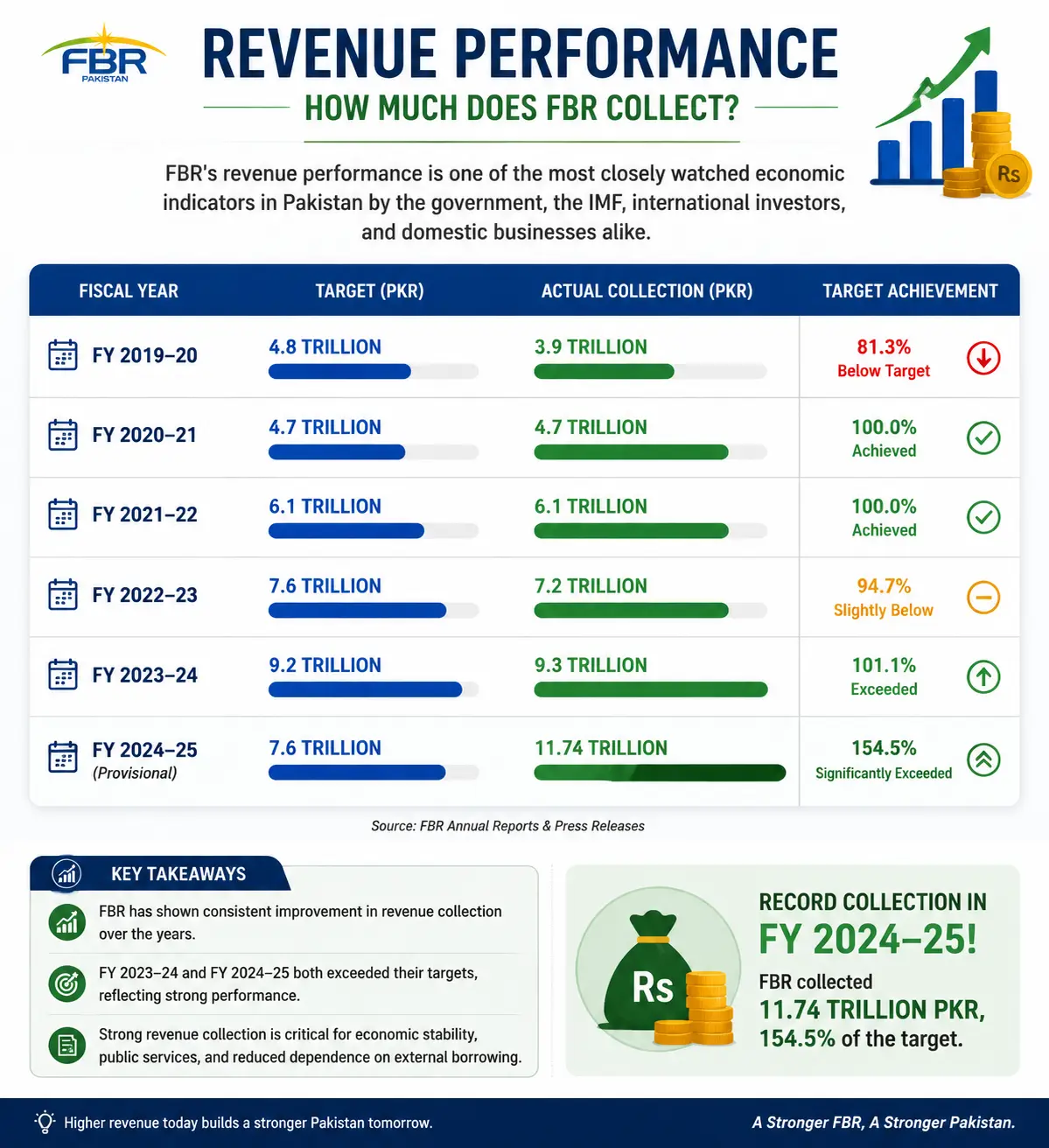
FBR's revenue performance is one of the most closely watched economic indicators in Pakistan by the government, the IMF, international investors, and domestic businesses alike.
Recent Trends
Fiscal Year
Target (PKR)
Actual Collection (PKR)
FY 2019–20: 4.8 trillion - 3.9 trillion
FY 2020–21: 4.7 trillion – 4.7 trillion
FY 2021–22: 6.1 trillion, 6.1 trillion
FY 2022–23: 7.6 trillion, 7.2 trillion
FY 2023–24: 9.2 trillion, 9.3 trillion
FY 2024–26: 7.6 trillion 11.74 trillion
During the fiscal year 2024–25, the Federal Board of Revenue (FBR) provisionally collected an estimated Rs. 11,735 billion to Rs. 11,744 billion, representing a substantial 26% increase from the previous year. Nevertheless, the FBR fell short of its ambitious annual objective of Rs. 12.3 trillion by approximately Rs. 1.2 trillion, despite this record collection.
Revenue Breakdown (FY 2024–25)
Direct taxes (income tax): ~38%
Sales Tax / GST: ~37%
Customs duties: ~15%
Federal Excise Duty: ~10%
Indirect taxes — GST, customs, and FED combined — account for nearly 62% of FBR revenues. This is a regressive structure: indirect taxes fall more heavily on lower-income groups who spend a higher proportion of their income on taxable goods.
Why Revenue Matters Beyond the Headlines
FBR's collections directly fund the Federal Divisible Pool, which distributes revenues to provinces under the National Finance Commission (NFC) Award. Provincial budgets face pressure when FBR fails to meet targets. Under the current IMF Extended Fund Facility, Pakistan has committed to specific revenue benchmarks—missing them risks triggering reviews that can delay critical loan disbursements.
Challenges: What Is Holding the FBR Back?
Despite recent improvements, FBR faces deep structural problems that no single government has been able to fully resolve.
1. A Dangerously Narrow Tax Base
Only about 3.5 million Pakistanis file income tax returns — roughly 1.6% of the population. By comparison, India has over 80 million return filers. Large sectors of Pakistan's economy — including agriculture, the informal retail trade, and significant parts of real estate — remain largely outside the tax net, either by law (agriculture is a provincial subject) or by enforcement failure.
2. Overwhelming Reliance on Withholding Taxes
Over 70% of direct tax collection comes from withholding taxes—deducted at source from salaries, bank transactions, imports, and contracts. This is administratively convenient but masks the failure to tax actual income and profits. It also creates a heavy burden on the salaried class and formal businesses, while those in the informal economy pay very little.
3. Corruption and Discretionary Powers
FBR officers historically wielded wide discretionary powers—in audit selection, assessment, and settlement—that created opportunities for corruption. While reforms like computerised random audit selection have reduced some discretion, allegations of bribery and selective enforcement remain a persistent public concern.
4. Harassment of Compliant Taxpayers
A damaging irony exists: paradoxically, those who register and file returns face greater exposure to FBR notices, audits, and compliance burdens. Many compliant businesses report feeling targeted while genuinely noncompliant entities go undisturbed. This creates a perverse disincentive to formalise. Finsmart Pakistan, #1 FBR Digital Invoice Software, perfect for all industries, helps streamline the process, ensuring compliance while minimising the hassle of dealing with these bureaucratic challenges.
5. Weak Automation Outcomes
The disparity between the actual compliance outcomes and the investment in IT systems (IRIS, WeBOC, and Track&Trace) persists, despite the substantial investment. Downtime, usability complaints, and limited data integration across agencies have plagued PRAL's systems.
6. The Refund Crisis
FBR owes exporters and businesses billions of rupees in outstanding sales tax and income tax refunds. Delayed refunds—sometimes running years—impose a significant liquidity cost on businesses, particularly exporters, and undermine confidence in the system.
Recent Reforms and the Road Ahead
The government and FBR have introduced a range of reforms recently, driven partly by domestic priorities and partly by IMF conditionalities.
Broadening the Tax Base
The 2024 Finance Act introduced income tax on agricultural income at the federal level for the first time, complementing provincial efforts. The government has also targeted the retail sector, requiring large retailers to integrate point-of-sale systems with FBR's real-time monitoring.
Track & Trace
The Track & Trace system enables FBR to confirm that sales tax has been paid on each unit by affixing digital markings to cigarettes, beverages, cement, and fertilizers. Early results have been mixed, with legal challenges from some manufacturers, but the system represents an important step toward real-time revenue assurance.
Incentive-Based Compliance
The Active Taxpayer List (ATL) has proven to be the FBR's most effective compliance tool. Non-filers pay significantly higher withholding tax rates on banking transactions, property purchases, and vehicle registrations—creating a direct financial incentive to file. The ATL is updated weekly and is publicly searchable.
Structural Reform Debate
A growing body of expert opinion—including from the IMF—argues that the FBR's twin roles of policymaking and revenue collection should be separated into distinct bodies. The argument: When the same institution both writes the rules and enforces them, accountability suffers. Pakistan has discussed creating a separate revenue authority on the model of HMRC (UK) or SARS (South Africa), but no formal restructuring has taken place yet.
What It Means for You: FBR and the Ordinary Pakistani
Whether or not you have ever filed a tax return, FBR affects your life every day.
How FBR Touches Your Money
Your salary: Employers deduct income tax at source (withholding) before you receive your pay.
Your mobile top-up: A withholding tax is deducted on every prepaid recharge.
Your utility bills: Sales tax is embedded in electricity and gas bills.
Your bank account: Interest/profit on savings is subject to withholding tax; non-filers pay a higher rate.
Your grocery shopping: GST is embedded in the prices of most packaged goods
Buying a car or property: Non-filers pay significantly higher transaction taxes.
The Benefits of Being a Filer
Being on the active taxpayer list is not just a legal obligation—it has direct financial benefits:
Lower withholding tax rates on banking transactions
Lower rates on property purchases and sales
Lower rates on vehicle registration and transfer
Eligibility for refunds of excess tax deducted
Ability to claim input tax credit (for businesses)
How to Register
If you earn above the taxable threshold (currently PKR 600,000 per year for salaried individuals) or run a business, registering is straightforward.
Visit iris.fbr.gov.pk and create an account.
Apply for your NTN (National Tax Number) online.
File your annual income tax return by September 30 of each year
Check your filer status on the ATL (searchable at fbr.gov.pk).
FBR also offers facilitation desks at all RTOs and a helpline (0800-00227) for assistance.
Your Rights as a Taxpayer
FBR has published a Taxpayer Rights Charter that guarantees the following:
The right to be treated with courtesy and professionalism
The right to receive clear explanations of decisions affecting you
The right to appeal any FBR decision
The right to confidentiality of your tax information
The right to representation (by a tax consultant or lawyer)
If you feel these rights have been violated, you can contact the Finsmart FBR Complaint Management System or the Federal Tax Ombudsman—an independent office established to redress taxpayer grievances against the FBR.
Conclusion: The Institution That Funds Pakistan
The Federal Board of Revenue is not a distant bureaucracy irrelevant to ordinary life. It is the institution that funds the state, its schools, hospitals, defence, and debt repayments. Its failures are not merely administrative inconveniences; they are fiscal crises that force the government to borrow abroad, cut development spending, and raise prices through indirect taxes that fall hardest on the poor.
Reforming FBR — broadening the tax base, reducing reliance on withholding, cracking down on the informal economy, and rebuilding trust with compliant taxpayers — is arguably Pakistan's most important structural economic challenge.
The good news is that the tools exist. Countries with similarly sized economies have achieved tax-to-GDP ratios of 15–20%. Pakistan's potential tax base, if fully captured, could fund a transformational improvement in public services.
But it requires political will, institutional independence, and a citizenry that understands why this issue matters.
Do you think FBR can fix Pakistan's tax culture—or does the problem run deeper? Share your thoughts in the comments below.
This post is intended for educational and informational purposes. Tax laws and FBR policies change frequently—always consult a qualified tax consultant for advice specific to your situation.
1. Who needs to register with FBR and obtain an NTN?
Anyone earning taxable income in Pakistan, including individuals, businesses, and freelancers, must register with FBR and obtain an NTN.
2. What’s the difference between a filer and a non-filer?
Filer: A person who has filed their income tax return with FBR and is compliant with tax laws.
Non-Filer: A person who has not filed their income tax return. Non-filers face higher taxes and restrictions.
3. How do I file my income tax return with FBR?
Register and create an account on FBR’s IRIS portal.
Fill out the tax return form (ITR-1, ITR-2, etc.).
Submit online and pay any taxes due.
Receive acknowledgement from FBR.
4. How can I claim a tax refund from FBR, and how long does it take?
File your return and show excess taxes paid.
Submit a refund request on FBR's IRIS portal.
FBR reviews and processes the refund, typically within 60-90 days.
Written by
Muhammad Omair
Digital Invoicing & Tax Compliance Specialist at FinSmart
Muhammad Omair specializes in FBR Digital Invoicing, e-invoicing compliance, ERP integration, and financial automation solutions. He regularly publishes insights on tax compliance, invoice management, and digital transformation for businesses in Pakistan.
Connect on LinkedIn